This week, I’ve been editing the final books of Chapter By Chapter, my guide to all 1,189 chapters of the Bible, and a question occurred to me:
Why is Daniel a Major Prophet when it has only twelve chapters, but Hosea is a Minor Prophet with fourteen?
It turns out the answer is really simple, but the reason the question arose reminded me of something interesting about how we read the Bible.
How Long is Daniel?
It turns out the distinction between Major and Minor Prophets comes from the lengths of the books, not their importance. The twelve shorter books were traditionally collected not as “Minor Prophets” but as the “Book of the Twelve.” Daniel himself is a little weird: Christian Bibles group it with the Major Prophets, but Jewish Bibles put it with the Ketuvim (Writings).
The thing that threw me off is that Hosea has more chapters than Daniel, but Daniel is a lot longer. Here’s a very obviously ChatGPT-generated chart of the difference (the math is right, I promise).
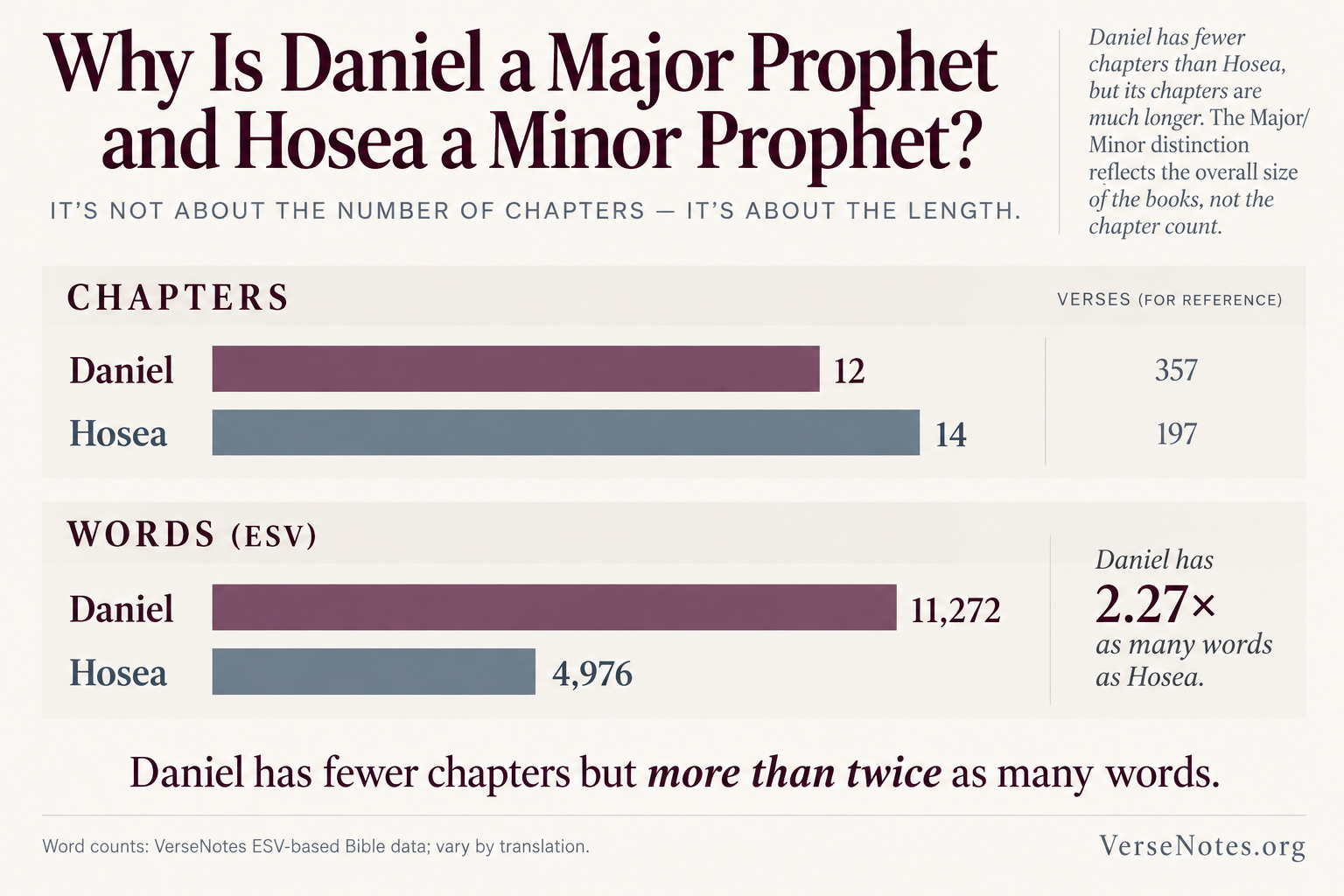
With 11,272 words, Daniel is more than twice as long as Hosea at 4,976 words (ESV translation).
In fact, when you look at them together, it turns out the Minor Prophets are really, really short. Zechariah is the longest, and it’s still only 54% as long as Daniel, the shortest of the Major Prophets. The shortest, Obadiah, is only 614 words long (a single chapter, shorter than this blog post).
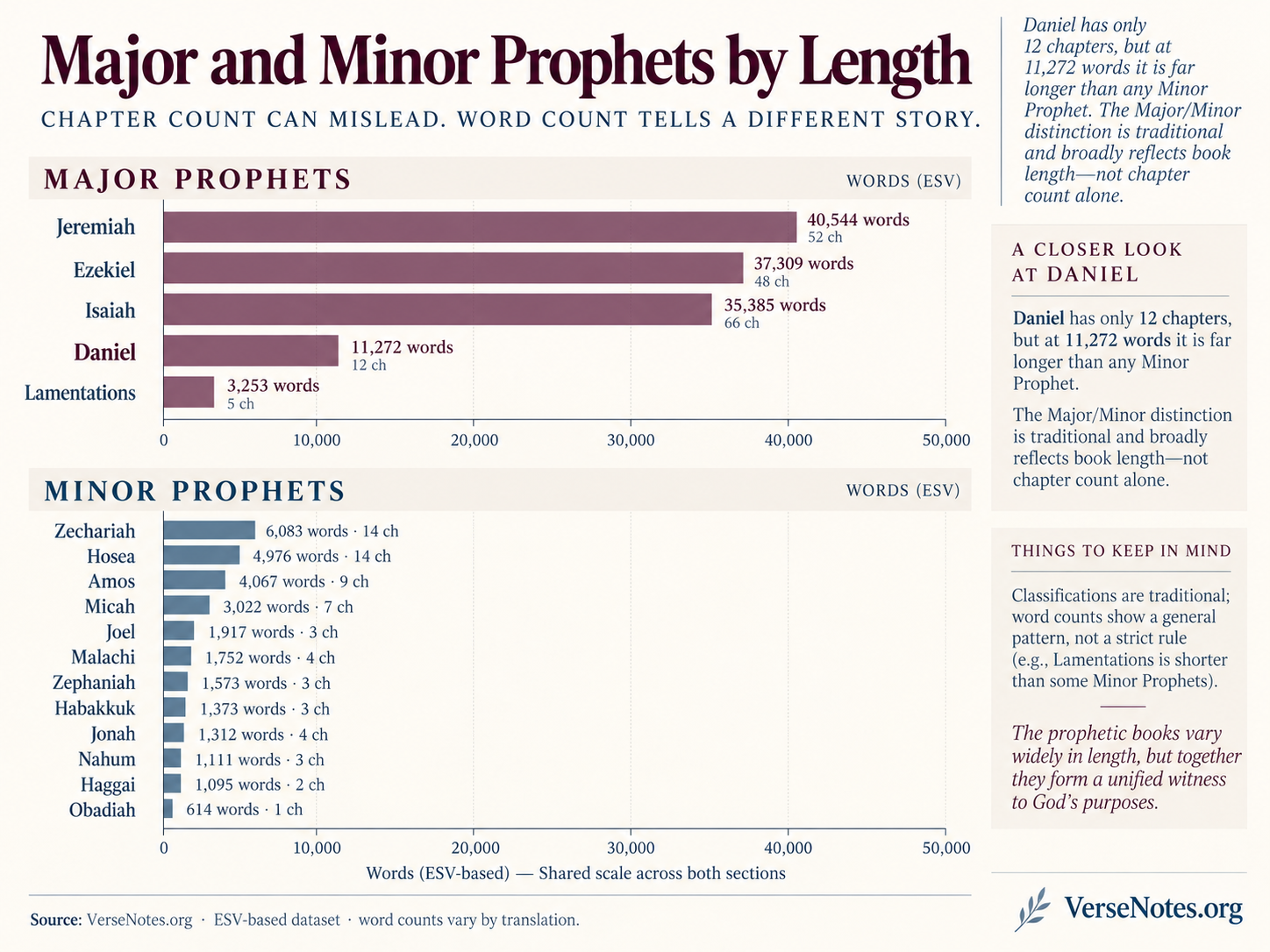
So what happened here? As usual, the answer is some weird thing that happened after the books were written.
The Map and the Territory
For my Chapter By Chapter guides, I give myself the same word budget for every chapter of Scripture: no more than 150 words to summarize what happens and explain what it means.
Which means Daniel can have up to 1,800 words of commentary, but Hosea can have up to 2,100.
This project has been going on for more than three years, and over that time I’ve sort of inadvertently trained myself to think of chapters as standardized units of length. Each chapter receives approximately the same editorial attention in the finished product, regardless of how much Scripture it contains.
Of course, in reality, chapters vary widely in length. Psalm 117 is two verses long, while Psalm 119 is 176. (Of course, verse lengths vary too.) And, for reasons I’m sure made sense at the time, chapter divisions don’t always correspond neatly to the natural divisions of a story or argument.
If I had infinite time, I’d have preferred to write “Passage By Passage”. I’d divide the Bible into logical thought units and explain each one—in 150 words or less, of course. That would have been a much more natural approach, but it would also have meant deciding where every passage begins and ends. I’d easily have ended up with more than 2,000 entries, each requiring its own research, writing, and editing. And worse, my readers would have had to read more carefully because my work wouldn’t line up neatly with the way their Bibles are organized.
From a more practical perspective, doing this for 1,189 chapters has already been an enormous multi-year undertaking. Adding thousands of editorial decisions and hundreds of thousands more words might have turned this project that’s nearing completion into something that never saw the light of day.
Instead, these imperfect chapter divisions gave me a finite, manageable, (nearly) universal structure. They made this ambitious project possible.
I had, briefly, mistaken the map for the territory, and it’s important to remember that they’re not the same thing.
But also: I think Chapter By Chapter is a good map, and a good enough map can help you cross an awful lot of territory.