Extending your streak one more day won’t make Jesus love you any more.
Consistent, faithful, daily Bible reading can be a great thing: it feeds your faith, fixes your mind on God, restores your soul, and trains you in righteousness. The danger arises when reading the Bible morphs into maintaining your streak.
Streaks and dated reading plans apply that pressure in different ways. A streak gives you a number to preserve. A dated reading plan gives you a backlog to maintain. Both make the calendar part of the accounting, but the second one is where I get myself into trouble.
I don’t personally feel much need to maintain a streak of Bible reading1. My problem comes after I’ve already missed a day or two: now I’m behind. Thursday’s missed reading becomes unpaid debt. Skipping four days because of a work conference means now I owe the Bible four readings.
I don’t like being behind. I don’t like being in debt. I don’t like feeling guilty. So I try to cram a week’s worth of reading into a single plane flight. Or I stay up late trying to clear yesterday’s balance.
In short, I spend my energy on figuring out how to catch up instead of spending it on the Word itself. Here’s the distinction you and I both need to remember: you can be behind on a reading plan. You cannot be behind on the Bible.
App-Defined Success
Dated reading plans encode a particular definition of success: scheduled compliance. Apps that gamify that success with streaks raise the bar even higher: consecutive compliance.
A missed reading can come with much more than an empty checkbox. There’s a scarlet badge on the app every time I pick up my phone, and the interface says, “1 Missed Day.” Sometimes there’s a bonus push notification, just in case I’d forgotten to feel guilty.

Streaks add another comparison. Tuesday-Wednesday-Thursday produces a longer streak than Tuesday-Thursday-Saturday, even though both schedules involve returning to Scripture three times. My least-favorite version tracks not only my current streak but also my longest streak2. Suddenly there’s a personal record to compete with, and an implicit comparison with some ideal me that never misses a day.
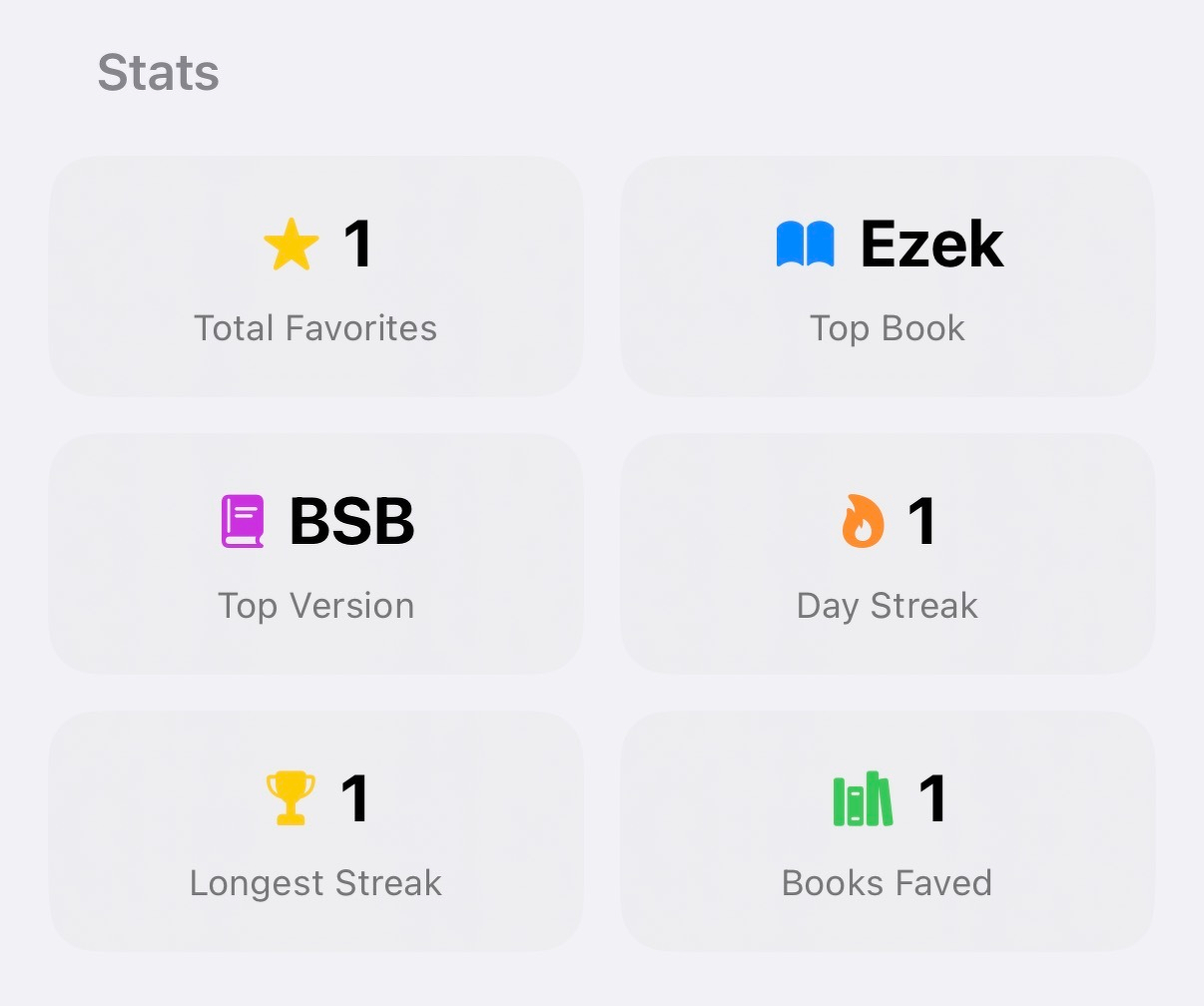
The implication of these design decisions is that longer streaks are better. Once the app has told me that 187 days is better than 186 days, it has made a claim about what should be optimized. The number isn’t just recording behavior; it’s shaping it.
I understand the appeal of encouraging a habit. Daily reading can be an excellent one. But when the number becomes the thing I’m trying to improve, my attention shifts toward making the number go up and away from what it’s supposed to measure. Attempted encouragement transmogrifies into an obligation.
When the Score Becomes Spiritual
The trouble deepens when I start reading the app’s score as a judgment on my faithfulness. I missed the assigned reading, so I’m behind. I’m behind, so I’m failing at something I ought to do. Before long, catching up feels like a spiritual obligation rather than merely a UX design choice.
Unconsidered consistency can turn the practice into its own justification. The streak becomes evidence that we’re doing well, even though the number tells us almost nothing about what we’re learning and even less about how we’re living.
Hosea confronts an ancient and deeper version of this problem: religious observance continuing while the people’s goodness disappears like morning dew. God calls for faithfulness that endures:
For I desire steadfast love and not sacrifice, the knowledge of God rather than burnt offerings.
—Hosea 6:6 (ESV)
The issue reaches beyond whether the religious activity happened or how long its unbroken streak was observed. Through Hosea, God encourages us to ask instead, What kind of life is growing around those observances? Where are the goodness and the knowledge of God they ought to express?
Daily Scripture reading can be wonderful. But checking the daily box cannot, by itself, tell me whether its purpose is being fulfilled. You don’t earn crowns when your streak hits 365.
Toward Better Bible Reading Apps
The design question, then, is how an app can help me return to Scripture.
A useful reading history could help me find a passage I want to revisit. A bookmark could hold my place. A review schedule could help me remember a verse. Each of those features would help me interact with Scripture directly.
The Bible Memory App offers an example of scheduling that serves a specific purpose. It uses spaced repetition to help me memorize Scripture, with reviews scheduled at intervals as I learn the verses.
When I started using it, I still had to turn off the notifications, streaks, achievements, and gamification features3. But I kept the review scheduling. Every time I choose to open the app, it can still tell me which verses are ready for review.
The distinction between empty streaks and useful reviews is important. The review schedule helps me decide what to practice. I can use that information when I arrive without receiving a stream of reminders about my absence.
A reading plan can serve a similarly specific purpose: helping me work through Scripture without having to decide what comes next every time I open the Bible.
To be fair, some apps already let me adjust the schedule. YouVersion’s “Catch Me Up” feature can move the current reading to today without marking “missed” readings complete. That’s a useful option—but returning without a backlog should be the ordinary experience, not a special case.
The ideal Bible reading plan has no concept of “behind.” Every time I open it, it should just say:
Welcome back. Here’s your next reading.
If I stopped at Hosea 4 last Thursday, Hosea 5 is today’s reading. Nothing has been lost. Nothing needs to be repaid. I have returned.
Time to Read Deeply
When I started taking Bible reading seriously fifteen years ago, an app like this would have changed how I read.
It would have saved me days of guilt, nights of lost sleep, frantic weekend catch-up sessions, and, worst of all, shallow reading. It would have let me spend twenty-four hours thinking about one passage or selection of passages rather than cramming six into one sitting to make the numbers work out right.
Today, I choose my reading plans and tools more carefully. I turn off the reminders that make returning feel like settling a debt. When I miss a day, I move the plan so that last Thursday’s reading becomes today’s. I still get to read the whole thing, with room to give each reading my attention.
If daily reading helps you encounter Scripture, by all means, read every day. But don’t maintain a streak for its own sake. When a badge or a reminder makes it harder to return attentively, turn it off. Give yourself time to consider what you’re reading.
God gave you a wealth of Scripture to return to for a lifetime. You are never behind.
-
Don’t ask how many days in a row I’ve done every single LinkedIn puzzle. ↩︎
-
It’s possible to hide the stats on the app home screen. But the default is to put them right there in your face every time you open the app. ↩︎
-
Obviously, all those engagement-farming features should be off by default. But at least it gives you the option. ↩︎